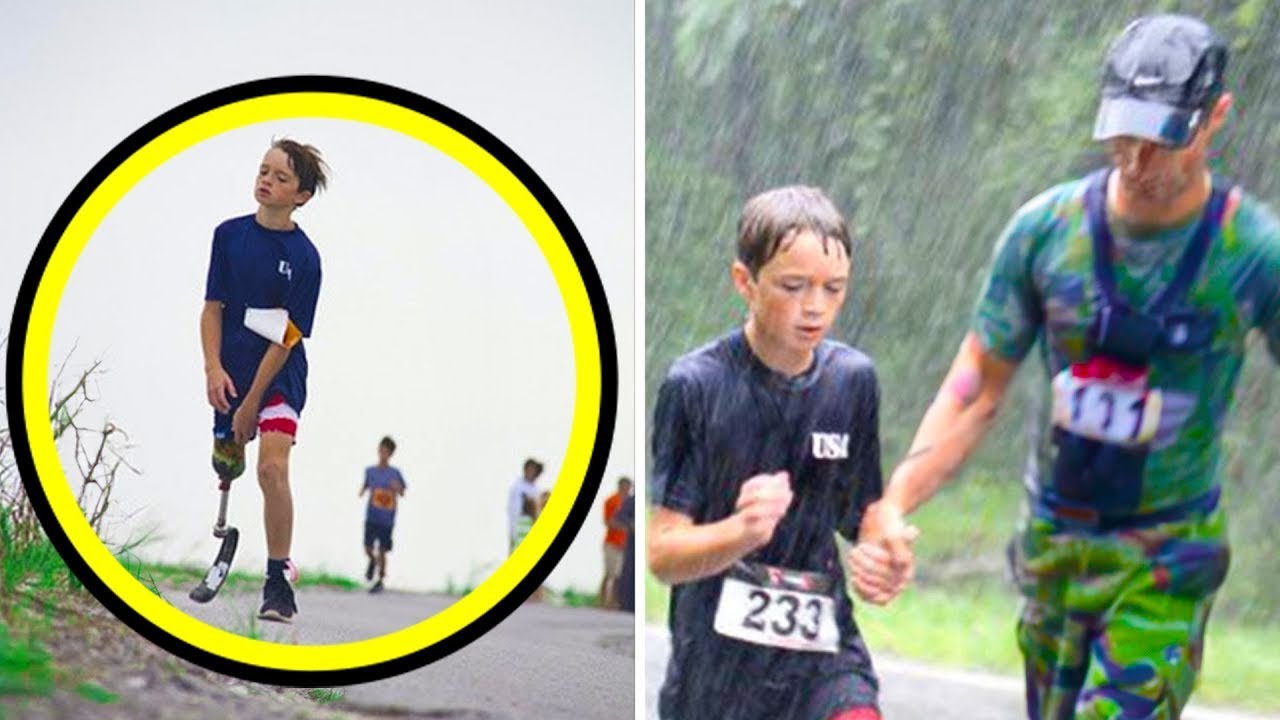
Veteran Helps 9-Year-Old Boy During Triathlon in Emotional Moment
A Race Meant to Test Strength
Triathlons are designed to push athletes beyond their limits. Combining swimming, cycling, and running, these races demand endurance, focus, and mental resilience. For adults, finishing a triathlon is an achievement. For a 9-year-old boy, simply showing up is an act of courage.

On this particular day, spectators gathered expecting to watch determination, competition, and athletic spirit. What they witnessed instead was a moment that reminded everyone why sports exist beyond medals and finish lines.
A Young Competitor With Big Dreams
The boy stood at the starting area, helmet slightly oversized, shoes carefully tied. His face showed excitement mixed with nervous energy. He had trained for weeks, supported by family and coaches who believed in him.
Like many children his age, he dreamed not of winning, but of finishing — of proving to himself that he could do something hard.
The crowd cheered as the race began.
The Race Takes Its Toll
As the triathlon progressed, the physical strain began to show. The swim drained his energy. The cycling segment tested his balance and stamina. By the time the run began, his legs felt heavy.
Each step forward required effort far greater than he had anticipated.
Children’s endurance events are carefully monitored to ensure safety, but they still demand real strength. Many young athletes hit a wall — both physically and mentally.
Struggling in the Middle of the Course
Halfway through the run, the boy slowed down. His pace faltered. Tears welled in his eyes. The cheers around him faded into noise as doubt crept in.
He wasn’t sure he could finish.
Moments like this are common in endurance sports. Athletes — regardless of age — often face a mental breaking point where quitting feels easier than continuing.
An Unexpected Figure Steps In
That was when a man approached from the sidelines.
He was a military veteran, standing among spectators. He had come to watch, not to participate. Yet when he saw the boy struggling, something compelled him to act.
He didn’t shout. He didn’t draw attention.
He simply stepped closer.
A Quiet Act of Kindness
The veteran crouched beside the boy and spoke calmly. He didn’t push or pressure him. Instead, he offered encouragement — words of reassurance, belief, and calm strength.
According to those who witnessed it, he told the boy that finishing wasn’t about speed, but about heart.
The boy looked up, wiped his face, and listened.
A Lesson Beyond the Race
Military veterans often speak about perseverance, discipline, and pushing through adversity — lessons learned not only in training, but in life itself.
Sports psychologists note that positive encouragement during moments of stress can significantly change outcomes, especially for children.
🔗 https://www.apa.org/topics/sport-exercise/children-sports
In that moment, the veteran became more than a spectator.
Running Together, Not Competing
Instead of leaving, the veteran stayed alongside the boy, walking and jogging just enough to keep him moving. He didn’t carry him. He didn’t interfere with the race.
He simply stayed present.
Step by step, the boy regained confidence.
The Crowd Begins to Notice
Slowly, spectators realized what was happening. The energy shifted. Cheers grew louder, not for speed or placement, but for perseverance.
People clapped not because they expected a victory — but because they were witnessing humanity in motion.
Sportsmanship often shines brightest when competition fades into the background.
The Final Stretch
As the finish line came into view, the boy straightened his posture. His pace improved. His face changed — determination replacing tears.
The veteran slowed, allowing the boy to move ahead.
This moment belonged to the child.
Crossing the Finish Line
The boy crossed the finish line on his own feet.
He didn’t win a medal. He didn’t break a record. But he accomplished something far more important — he finished despite wanting to quit.
The crowd erupted in applause.

An Emotional Aftermath
After the race, the boy hugged the veteran. His parents, watching from a distance, struggled to hold back tears. What had begun as a sporting event had transformed into a memory that would last a lifetime.
Acts of kindness in youth sports have been shown to leave long-term positive impacts on confidence and resilience.
🔗 External reference: https://www.npr.org/2022/05/08/youth-sports-mental-health
Why This Moment Resonated
This story resonated not because it was dramatic, but because it was human. It reminded viewers that strength is not always loud, and leadership doesn’t require authority.
Sometimes, it’s a quiet voice saying, “You can do this.”
The Veteran’s Perspective
Later, the veteran reportedly explained that he saw himself in the boy — someone facing a challenge bigger than expected. He didn’t see weakness. He saw effort.
For him, helping was instinctive.
Lessons for Everyone Watching
The moment offered powerful lessons:
-
Success isn’t always about winning
-
Encouragement can change outcomes
-
Kindness has no age requirement
These lessons apply far beyond sports.
A Story Shared Around the World
The story was later shared online, where it quickly gained attention. Viewers from different backgrounds connected with the emotion of the moment.
Human-interest stories like this often spread because they restore faith during times when negativity dominates headlines.
More Than a Race
In the end, the triathlon became secondary. What mattered was the connection formed in a moment of vulnerability.
The boy learned he could push through doubt.
The veteran proved that service doesn’t end with uniform.
Not About Rules, But Values
Importantly, this story is not presented as an official race account or competitive ruling. It is shared as a human-interest narrative focused on values, not regulations.
That distinction keeps the story honest and meaningful.